Management of the Burn Patient (3 hours - Basic, Intermediate & Paramedic levels) |
 ________________________________________________________________________________________ ________________________________________________________________________________________
Purpose: To review all aspects of care for the burn patient, from the anatomy and physiology of the skin to treatment and transport. Goal: To better enable the EMT to care for a burn patient Objectives: - To review the anatomy and physiology of the skin
- To discuss on scene hazards to the patient and the EMT
- To review methods of extinguishing a burning victim
- To review inhalation injury and respiratory care for a burn patient
- To review the definition of moderate and critical burns
- To review the causes of and care for a patient suffering from the following burns in the field: thermal burns, chemical burns, electrical burns, lightening burns and radiation injury.
- Special consideration for the pediatric burn patient
- To review Region I protocols
- Anatomy and physiology of the skin (10 minutes)
- Accident scene survey (10 minutes)
- Scene assessment
- Hazards to patient(s), EMT(s), and bystander(s)
- Mechanism of injury
- Best access to patient(s)
- Moving the patient to safety (10 minutes)
- Review of rapid extrication techniques
- History taking and assessing the burned patient (10 minutes)
- Primary survey
- Secondary survey
- Respiratory Care for a burn patient (15 minutes)
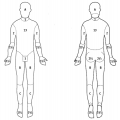
- Rule of Nines (5 minutes)
- Adult
- Pediatric
- Degree of Burns (10 minutes)
- First degree burns
- Second degree burns
- Third degree burns
- Definition of moderate and critical burns (5 minutes)
- BLS & ALS management of thermal burns in the prehospital setting (20 minutes)
- Special considerations in the burned infant (10 minutes)
- BLS & ALS management of chemical burns (20 minutes)
- Special cases of chemical burns
- Alkali burns
- Hydrofluouric acid
- Sodium metals and sulfuric acid burns
- Hot tar burns
- Chemical burns of the eye
- BLS & ALS management of electrical burns (15 minutes)
- BLS & ALS management of lightening injuries (15 minutes)
- Review of Parkland formula for fluid replacement (5 minutes)
- Transporting a patient with burns (5 minutes)
- Third spacing (5 minutes)
- Review of Region I protocols (5 minutes)
- Question & Answer period (5 minutes)
|



